


It should be no surprise that, since reaching a near-monopoly of the entertainment space, Disney has pivoted their strategy away from generation-defining films in favor of a safe, risk-free route beloved by none. The constant trend of remakes and reboots wasn’t started by the House of Mouse, but year after year, Disney finds itself committing another crime against the cinematic medium by dragging the brutalized corpse of yet another profitable property out of the morgue to be whipped and beaten for audience entertainment.
Perhaps I’ve been a bit hyperbolic here. It would be a gross exaggeration to say that Disney leads the industry’s push towards projects that already have a proven consumer base, but it tends to be its greatest beacon of criticism. Since 2010, Disney has adapted 15 of its animated classics into live-action, big-budget retreads, with (arguably) only two having been remarkable (those being Pete’s Dragon and The Jungle Book). The others were embarrassing attempts to desperately cash in on familiar iconography and a consumer base unwilling to assign standards to their interests.
To Hollywood, anything can be zombified if you try hard enough. Perhaps the most popular application of this theory was 2019’s Joker, which, aside from a few nods to the Batman mythos, feels like an independent narrative that identifies itself as distinct from the source material. Big budget production companies want to work with critically acclaimed directors, but don’t want to run the risk of creating something offputting. Chloe Zhao’s Eternals for Marvel Studios appears to follow the same path, as does Barry Jenkin’s planned Lion King movie. The creative optimism of smaller directors meets the marketing cynicism required to develop these projects, allowing corporations to develop creatively fulfilling projects by using familiar products as a safety net.
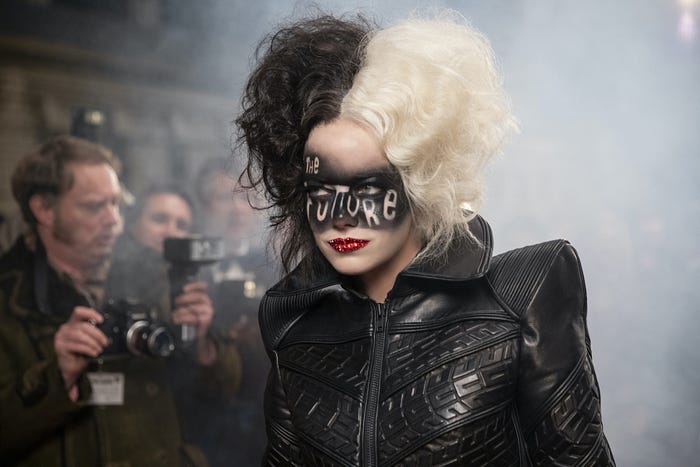
Review:
Cruella marks the first live-action Disney film to debut in theaters since the beginning of the pandemic, an unremarkable feat if not for the general gravity of the situation. The method of release adds nothing to the quality of the film, but I see it mentioned in most other reviews so I see no reason not to do so here.
Exploring the background of the classic Disney villain, Cruella uses the British punk revolution in the 1970s to outline a story dissecting generational divides across modern culture. The subtext is limited, but hiding deep within this film is a mildly nuanced perspective surrounding rigid social norms and those who seek to define them. A more seasoned critic would point out the confusing juxtaposition between a Disney film and a criticism of limited expression, but the confused politics of corporate art is not foreign to an avid consumer like me.
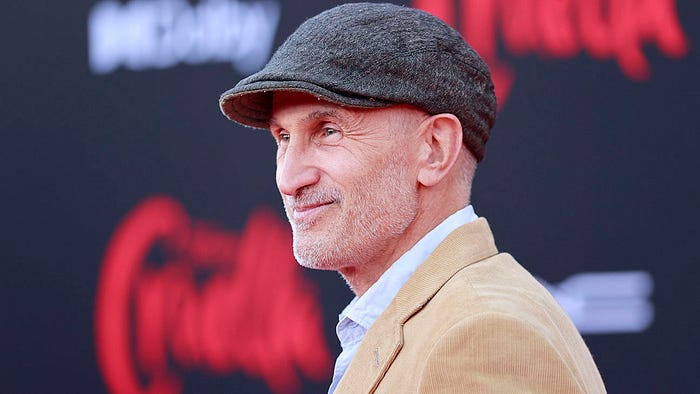
Following general success and popularity with I, Tonya, director Craig Gillespie steps into the corporate marketplace in hopes of introducing some charm to a creatively bankrupt landscape. However, like Ryan Coogler’s efforts on Black Panther, I couldn’t help but feel like these auteur-driven blockbusters identify a clear ceiling in the subcategory. Despite their previous successes, neither director was able to balance creative freedom and the boardroom requirements that guide their respective films. For this reason, Cruella fails to find an identity of its own, capturing an emotion somewhere between lifelessness and freedom. The cinematography and camerawork feel inspired in a way that no recent Disney film has been, but these are in service of a disappointing narrative more focused on writing around a central conflict instead of in its supplement. Even with a talented director behind the project, navigating an already established foundation can undermine creative limitations beyond redemption.
I was initially off-put by the film’s runtime, which amounts to an incredibly unwarranted 134 minutes. Not only because it’s incredibly long, but because the source material provides little in terms of interesting background for the character to develop upon. Cruella de Vil is a stereotypical villain, all the way down to a deliciously indulgent hatred of innocent puppies, which provides very little to expound upon. However, not a single scene in Cruella feels superfluous, and I found myself constantly engaged with the film despite this uphill battle. If a scene didn’t push the film along, it was aiding in character development or world-building. Perhaps those engaging with the film are used to processed puff-pieces that “trim the fat” to cut down the runtime, but I was delighted to see a big-budget film retain the meandering pace of a smaller piece.
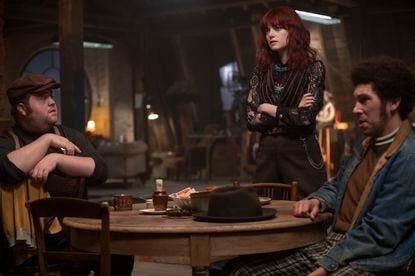
That potentially excessive runtime is supported by a solid cast who, while not groundbreaking, did a serviceable job with the given material. Joel Fry and Paul Walter Hauser are an especially brilliant duo, delivering much of the film’s charm and cartoonish wit. In fact, the entire supporting cast does a wonderful job maintaining the film’s levity, something required by the somewhat oscillatory performances given by Emma Stone and Emma Thompson. One moment their conflict is believable and charming, and in another, they’re unbearably stiff as they regurgitate dialogue necessary for plot progression. Where Thompson peaks at the moment her character is fully realized, Stone excels at her introduction.
That criticism is somewhat directed to the actors but is mostly at the rather underdeveloped script. The film can’t decide whether it wants to divorce itself from any fanservice or indulge in referential archetypes, something incredibly apparent by the ways it infrequently shoehorns the familiar concepts at a confusing rate. For example, in the same way, Joker stumbled over any references to Bruce Wayne, Cruella has an incredibly difficult time justifying the character’s name. Emma Stone plays Estella who, upon acting rather rude one day, is called Cruella by her mother, something so unbearably hamfisted that I couldn’t resist a hearty facepalm.
At various points of the film, the same thing can be said where the conversational and rather genuine dialogue slips into cookie-cutter bullet points that lazily drag the plot to completion. The film awkwardly focuses on Cruella’s punishment at school in service of a mild dalmatian reference (black dots on white paper), Roger never receives character development and yet is lifted to the necessary spotlight under being important in the source film; all familiar hallmarks in the scripts of lazy cinematic remakes.
The film is a visual “mixed-bag”, featuring some of the most elegant costume designs met face-to-face with some of the worst special effects I’ve ever seen. The film bases its narrative on fashion design, which gives the costume crew and set designers a brilliant chance to flex their creative muscles. As the competition between Cruella de Vil and the Baroness (Thompson’s character) comes to a climax, the film appears to swiftly move from one brilliant outfit to the next. Even for characters not directly related to the fashion conflict, the diverse wardrobe really captures the freedom felt in the animated medium. Characters don’t need to look realistic to the point of boredom, rather, the film can use costuming in the same way animated films design a character. The animated film gives Cruella proportions more beastly than human, and the live-action interpretation captures this with an emphasis on deep, bold, and demanding colors.
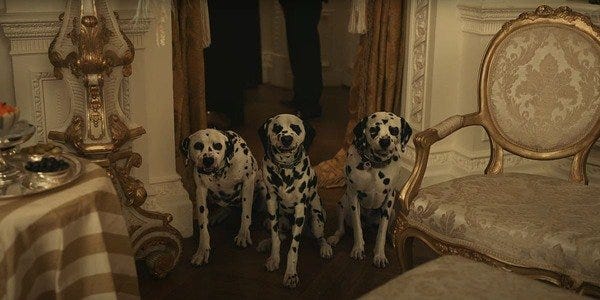
That said, I can’t say I’ve seen special effects this bad since 2016’s Black Panther. Audiences will immediately recognize the use of a green screen both during the film’s opening and climax, something genuinely unforgivable at a $100-$200 million budget. CGI animals look dated as if they were pulled directly from the source files of an early 2000s fantasy film (just look at one of the dalmatians for a few seconds to see what I mean). In fact, the film once again rides a fine line in this department as well, constantly bouncing between being visually unique and unbearably amateur. A fashion show at the Regent’s Park fountain really captures the energy of the punk movement, which is the film’s most inspired and creative moment. Yet, in a confusing decision, the film’s only one-shot(much earlier in the film, to be clear) appears to be filmed at two-times speed. In my mind, the whole point of an unbroken shot is to express fine details in a seamless manner, something fundamentally impossible without giving it time to breathe. How can one film be so daring and yet so impossibly ignorant?
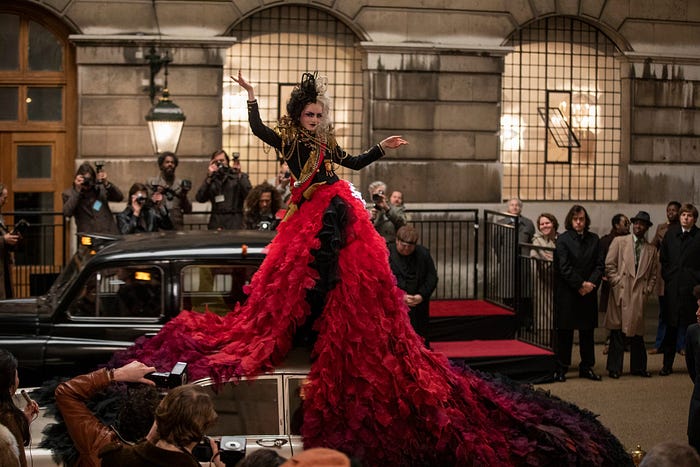
Perhaps one of the most annoying aspects of the film lies in its editing, both in the intrusive way it undermines the pacing of scenes and the embarrassingly focusless soundtrack that the film would’ve benefitted without. For the most part, the film is shot like a standard action/heist film, but inconsistent applications of uncomfortably intrusive edits only serve to pull audiences out of the narrative. There’s one particularly egregious scene transition the film uses multiple times which fundamentally ignores the concept of the film. As Cruella rises through the fashion industry (much to the dismay of the Baroness), the film overlays a montage of her escapades with newspaper headlines. It makes sense in the film, Cruella is using a newspaper to bolster her popularity, but editing it into the film gives the impression that the paper is more important than the plot has lead on. After a short introduction, the paper only becomes useful for these intercut edits, something that would feel more appropriate in a film about… newspapers. I couldn’t help but feel that, while imaginative, these choices almost directly contrasted the direction of the film thus far (I did like the one where she’s on top of the car though. Honestly if it wasn’t newspaper styled and focused more on punk sketching it would’ve been dope).
For some reason, the film features an excessive number of needle-drops, each rarely lasting more than thirty seconds (some immediately play one before another). There’s nothing wrong with playing popular music during a film, Scorsese and Gunn have done incredible jobs with this practice, but doing so requires a masterful knowledge of both music history and film scores. Rather than improve the mood of a given scene by tying a song’s emotional weight to the film’s narrative, the momentary nods to punk classics leave the lasting impression of a teenager’s Spotify playlist. Without properly integrating the tracks in a meaningful way, the soundtrack ends up feeling incredibly lazy. This is disappointing, but it inadvertently affects the visual aesthetic by commodifying the film’s theme.
This is all to say that while not a bad film, Cruella is ultimately not one of note either. It seems that despite giving the director incredible freedom in his pursuits, the project found very little use of these lax circumstances and delivered an average experience unfit for general attention. I anticipated feeling a wave of incredible anger or boredom from this film, and I was surprised not only at how little I despised it but at how little I cared. Cruella is a film that balances its creativity with amateur missteps, painting an incredibly uncertain picture for the future of auteurship in the big-budget marketplace.
At best, I think everyone can find something to enjoy here. It’s a mildly fun film that captivates throughout the lengthy runtime without overstaying its welcome. There are clear superiors in the world of live-action remakes, and yet I have been subjected to far worse by the same company. Perhaps the worst criticism I can levy on the film is of its mediocrity, eliciting perfect boredom as it meanders aimlessly. Cruella may not be a stifling example of corporate filmmaking, but it certainly isn’t the creatively expressive film many anticipated it to be.
Score: 6/10
Ryan Dorman is a Columnist and the Content Director for the Boardwalk Times. He can be found on Twitter at @OpentheDorman.


