This is the sixth part in my 21 part series reviewing the MCU films in chronological order. Reading these in chronological order is not a necessity, but will help understand the ways in which Marvel films improve or regress.
Written Review:
So, here we are at the end of the Marvel Cinematic Universe: Phase One. The Avengers brings together all the characters introduced so far in one ensemble piece reflective of the series’ sheer size. Thor, Iron Man, the Hulk, Captain America, Black Widow, Nick Fury, Loki, and Hawkeye are just a few of the characters brought back for this film, outlining the starpower Marvel has so far in the MCU.
One strong praise I have for this film is the directing and screenwriting style of Joss Whedon, managing to deliver some of the best onscreen chemistry so far in the MCU. All of the characters speak to one another in a manner so genuine that it would pave the way for future trends in MCU writing, and it’s done so well here that arguably the rest of the series tries to live up to the high bar this film sets. To exemplify this, one must not look further than the conflict on board the helicarrier, where the entire cast is boxed in one room but the scene never feels overly claustrophobic. Characters aren’t forced into situations, rather, it becomes easy to see the cast as genuine human beings. Though the film focuses on extraterrestrial evils, most of the plot is contained within the cast of characters and their individual motivations. A tactic James Gunn would later use for the Guardians of the Galaxy, Whedon recognizes that the best stories are grand in scope but contained narratively. Sure, the aliens attack Earth, but that serves as merely a background for the film. If that were to be the main plot, it would become convoluted, and the film chooses to focus more on fleshing out the already developed cast of characters and their responses to such dangers, as well as their difficulty adjusting to one another.
I must also recognize Whedon’s visual directing style, mirroring a comic book in a near perfect manner. In the films before, a darker tone was taken to better match the scope of the cinema. Comics maintain interest through color and pictures, but mainstream cinema tries to use the grittiness of camera as a drawing point. Choosing to ignore the work of previous MCU directors, Whedon pays homage to the comics by removing saturation (something other MCU films hinged on) and basing many of the visuals in a wide range of colors. For example, Captain America’s suit has been changed from a muted, multi-colored soldier’s garb to a vibrant red, white, and blue jumpsuit, almost akin to pijamas. Though it may look silly at first glance, this serves to distinguish Cap from the rest of the scene by using his bright colors as a contrast for the rest of the scene. In fact, all of the characters have one defining color that allows them to pop. Whedon clearly understands that defining traits will allow audiences to follow the action on screen with ease, as they can mentally associate colors with characters (Hulk — Green, Cap — Blue, Iron Man — Red, etc).
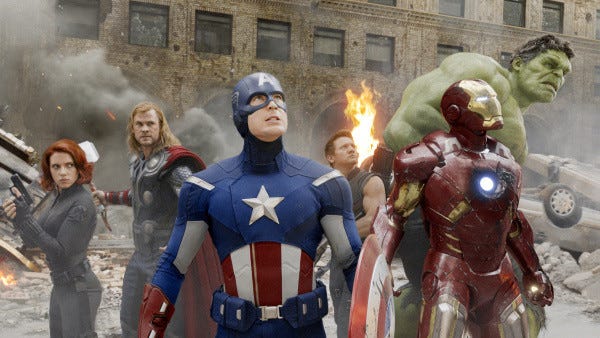
Nowhere is this better established than in the spinning shot at the climax of the film, a now iconic showcase of Earth’s Mightiest Heroes. That particular shot really identifies Whedon’s success in this film, mainly the ability to draw chemistry from these characters while respecting the source material in a way many were afraid to do. I mentioned in my previous reviews that multiple MCU films borrowed on Nolan’s gritty Dark Knight visual style as that was popular, but Whedon’s decision to explore the colors of the comics would not only benefit this film but continues to be the standard for MCU films (and arguably the rest of the genre). Inside the Helicarrier, the final battle in New York, and the fight between Thor, Cap, and Iron Man all ooze with comic style writing and shot choreography. There were many points where I realized that a freeze frame would be a perfect panel for a comic book,
In fact, the plot itself is perfectly simple in its own right. Just like a serial, the villain isn’t a momentus threat. Later films would curb this with villains like Ultron and Thanos, and as a kid I really disliked the fact that Loki wasn’t all too powerful, but I now realize the genius behind his subdued presence. Loki isn’t supposed to be this world destroying god, rather, he is a generic “villain of the week” too strong for one Avenger, but weak in the face of the whole team. The moment everyone recognizes the value of teamwork, the threat of Loki’s presence is strongly diminished. As I mentioned previously, the heart of the film isn’t centered at the conflict itself, moreso in the ways our favorite heroes join together to stop it.
However, I find myself disappointed that this film marks a turning point in the MCU. Whedon did a fantastic job bringing these characters together, but it’s a shame that they’ll never be apart from this point on. Marvel realized the box office success that comes from shared screen time, and that likely impacted the way they’d move forward with the universe. I certainly think origin stories from Marvel are often quite awful, and don’t wish they continue doing them, but I do think more breathing room for individual characters and series would do the narrative some good.
The Avengers is an extremely entertaining film that blends comic book action, colorful visuals, and dynamic character writing to near perfection. I genuinely forgot how much I like this film, and much of that is thanks to the clever writing and simple storyline. It’s at this point in the franchise where characters begin to feel right, and the movies become a fun time, if not a little shallow. The film hinges heavily on the previous MCU outings, but does so only in storyline rather than innate dependence. Contained and concise, The Avengers takes the MCU in a bold new direction in all the right ways.
I give The Avengers an 8/10. The film is a lot of fun, and I’m sure you’ll enjoy it.
Just to recap, here is my list from best to worst of MCU Phase 1 Films:
Ryan Dorman is a Columnist and the Content Director for the Boardwalk Times. He can be found on Twitter at @OpentheDorman, and as a host of the Boardwalk Talk podcast on iTunes.