


Never a man shy about his ambition or what he felt was an eternal necessity for innovation across numerous fields, it’s a late-life quote from Walt Disney that perhaps most effectively casts a grossly unflattering light on the contemporary state of an industry he helped shape: “In this volatile business of ours, we can ill afford to rest on our laurels, even to pause in retrospect. Times and conditions change so rapidly that we must keep our aim constantly focused on the future.”
While applicable to the modern iterations of several industries in which Disney was a pillar, the quote strikes particular resonance when read with present-day Hollywood in mind, as major studios have reached the paradoxical state of creative bankruptcy being their sole trusted source of box office returns. Gone are the days when significant resources and robust marketing efforts were dedicated to original, non-intellectual property-rooted films, with these luxuries now reserved for sequels to and remakes of movies that audiences have shown past interest in. One needs to look no further than the 2025 film release calendar for evidence of Hollywood’s borderline holistic reliance on IPs as the basis of new blockbusters, as only a cursory glance reveals that filmgoers will again be subject to a deluge of spin-offs, reboots, and brand-based cinema tailored to be as banal as possible as to not unsettle whichever particular fanbase they hope to cash in on.
This is by no means a new industry trend or one worth lamenting over in any significant capacity, as it’s simply the nature of the beast; that said, given Walt Disney’s demonstrated commitment to creative innovation, it’s disheartening to see the contemporary rendition of the company that bears his name be so reliant on its past accomplishments. The Walt Disney Company of today is one seemingly hesitant to take bold risks across any of its various arms, this idea perhaps most conspicuous across its numerous film studios; the conglomerate is, today, the apex atop seven major studios once one ascends far enough up the corporate pyramid (Walt Disney Pictures, Walt Disney Animation Studios, Pixar Animation Studios, Marvel Studios, Lucasfilm, 20th Century Studios, and Searchlight Pictures), most of which have fallen into the IP-vortex that plagues modern Hollywood.
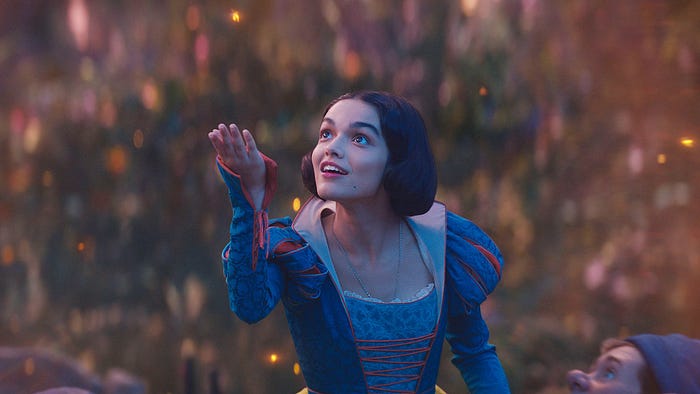
Walt Disney Pictures proper is perhaps the most consistent perpetrator of the fad, making a recent habit of adapting the company’s cherished animated library into ‘live-action’ films devoid of the heart, charm, and care that allowed the original movies to resonate with generations of audiences; though the studio flirted with the ‘live-action remake’ idea in the 1990s, it’s leaned into the strategy to the point of audience disparagement over the past 15 years, releasing 20 films either directly or tangentially related to the company’s animated canon since 2010. A staggering 16 of these have come in just the last nine years, with the critical and financial success of 2016’s The Jungle Book giving Disney confidence that there exists a bountiful market for what are essentially remakes of cinematic triumphs in an altered medium; while this was perhaps initially true, the incessant releases and their dwindling quality have prompted said market to sour, with the company’s latest live-action reimagining, Snow White, earning an underwhelming $42 million in its domestic opening weekend while scoring just a 42% on Rotten Tomatoes.
Disney, however, has no plans to hop off the proverbial live-action remake train anytime soon, with Lilo & Stitch — aptly based on the 2002 animated film of the same name — set to hit theaters in May 2025. Live-action Moana, Hercules, and Tangled adaptations are set to eventually follow, with the studio’s inexorable quest to ‘remake’ its entire animated library no longer sounding like hyperbole. Said animated canon, too, has seen a recent influx of sequels and IP-based releases, this despite Walt Disney Animation Studios historically reserving follow-ups to direct-to-video fare; the company’s legacy animation branch released sequels in 2018 (Ralph Breaks the Internet), 2019 (Frozen II), and 2024 (Moana 2), with three of the studio’s next releases also slated to be of the ‘franchise’ variety (Zootopia 2 in 2025 and Frozen III in 2027). Throw in the fact that additional Frozen and Encanto films are reportedly in development at Walt Disney Animation Studios and that new Toy Story, Incredibles, and Cocosequels are in the works upstate at Pixar, and one can quite easily deduce that the company’s reliance on proven intellectual properties is by no means exclusive to Disney proper.
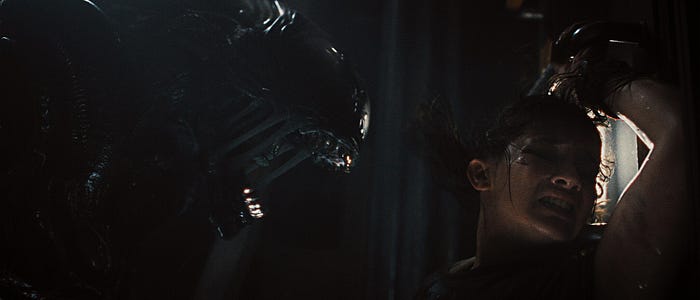
It’s, too, visible at Marvel Studios and Lucasfilm, which, while perhaps more excusable given their intended functions, are entities so intrinsically linked to their respective IPs that audiences know not to even expect ‘original’ releases. 20th Century Studios and Searchlight Pictures, to their credit, generally prioritize original films over remakes and reboots, but even they aren’t completely exonerated; 20th released fresh entries in The Omen, The Planet of the Apes, and the Alien franchises last year, with new Predator, Ice Age, and The Fly films either dated or in development at the studio (this isn’t even to mention the three Avatar films scheduled to release through 2031). Searchlight, meanwhile, is a production house more generally associated with smaller-scale films (bringing Disney its most Academy Awards in four of the last five ceremonies), but even the prestige studio greenlit a follow-up to the 2019 horror-comedy Ready or Not last year (fans, admittedly, seem quite open to that sequel, and if it’s not called Here I Come, what are we even doing here?).
Disney is by no means the lone company spearheading contemporary Hollywood’s IP-contingent state or the trend’s sole transgressor, but to watch a company historically associated with creative and technological innovation become so content with following a fad and falling subservient to its legacy is grim. And despite what this potentially doomist analysis of the creative state of the modern Walt Disney Company may suggest, I don’t think there’s anything inherently wrong with remakes and/or sequels, as there are a bevy of natural reasons why a story or property should be revisited or expanded upon in additional material.
Perhaps a lack of financial resources prevented a film from realizing its potential, or the technology necessary to effectively execute the concept was not yet readily accessible at the time of the film’s release. Perhaps the core idea of a movie was strong, but it needed a different set of creative eyes in order to be properly translated to the screen, or it was meddled with during production. Perhaps a film was stellar and concluded at a place that could be naturally picked up upon in a sequel. Given the sheer number of movies in existence, there are bound to be a few that left meat on the bone, and there’s nothing inherently wrong with revisiting these films through a modern lens and tackling them with contemporary techniques and technology, assuming the motivation is artistic as opposed to corporate. Creatively building upon a previously explored, but underserved concept or premise is welcomed, but this simply isn’t what Disney has been doing with much of its recent IP-based cinema.
With a century-spanning history and a compilation of major studios under its umbrella, Disney naturally has several films in its library that are ripe for revisitation, movies that, for one reason or another, failed to fully realize their potential and could benefit from an updated interpretation (or, in some cases, a narrative continuation). With that, I’ve scoured the release histories of the company’s various studios to gather seven films/properties that I feel could be built upon and more effectively executed if properly revisited today.
The Abominable Snowman (1957, 20th Century Studios)
In what is a surefire way to build credibility, I’m starting this list with an asterisk.
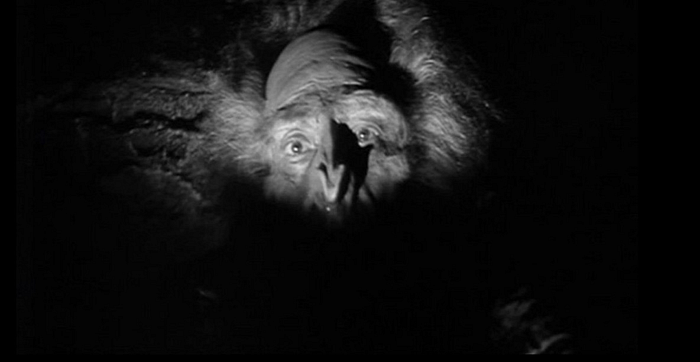
The Abominable Snowman, a 1957 psychological horror film that chronicles a Himalayan expedition’s treacherous search for the elusive Yeti, is not technically a 20th Century Studios property, as the company only distributed the film in the United States. The movie is instead an early ‘Hammer Horror’ picture, with Hammer Film Productions releasing the film justbefore it would find mainstream success in the form of its now iconic Universal Monster-adjacent outings (The Abominable Snowman hit theaters just three months after The Curse of Frankenstein, with the bulk of Hammer’s subsequent horror films focusing on characters popularized by Universal earlier in the century).
And though not technically a product of 20th Century Studios proper, The Abominable Snowman is a film begging for a contemporary mid-budget revisititation, as its premise and general blueprint have endured the test of time with shocking vigor despite the movie itself largely failing to do so. Led by Forrest Tucker and a pre-Grand Moff Tarkin Peter Cushing, The Abominable Snowman is not as much an exploitative creature feature as it is a meditation on mankind’s ambition, positioning the fabled Yeti (whose appearances are scant despite the film’s title) as a mirror that casts an unfalttering reflection of man as opposed to the source of jump scares. Without delving into narrative spoilers, the film explores man’s role in nature and his unwavering desire to control it while weighing value systems and motivation (scientific/natural vs. monetary/entrepreneurial), with the Yeti being far from the only monster in this quote-unquote monster movie.
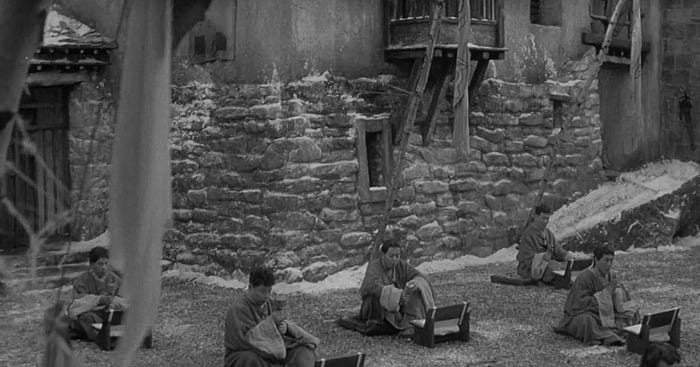
The immersive production and set design elevate this film far above the level of quality you’d expect from something of its genre or era, with these elements, alongside the sound editing and pacing, coalescing to craft a foreboding sense of tension and dread, a sensation only amplified by the aforementioned minimal sightings of the titular creature; hiding the Yeti from the audience allows them to envision the monster in their mind, potentially creating something far more unsettling than anything a low-budget film could’ve produced in the 1950s. And though the movie is certainly worth a watch nearly 70 years later, it’s far from a flawless outing; it juggles a lot of high-concept ideas, many of which fall by the wayside as the film speeds through its 91-minute runtime. It’s also far from subtle with its (still poignant) message, with the story and dialogue sometimes detouring into moral sermons that preach to the audience as opposed to allowing them to piece the themes together themselves (a common issue of ‘B-movies’ of the time); the general lack of the Yeti is also a just criticism from those expecting a more traditional monster movie, with the ultimate payoff perhaps being a bit underwhelming given the film’s restrictions.
Despite the movie’s flaws, its message is eternal and resonates just as heavily today as it did in the 1950s. A beautifully photographed modern take on the IP that delivers its message with the same psychological dread and a bit more subtlety (with perhaps a few more Yeti sightings to boot) likely wouldn’t break the bank for Disney, and it would give 20th Century (a studio that Disney has been treating as its ‘horror hub’ in recent years with films like Prey, The First Omen, and Alien: Romulus) yet another horror film to add to its, as of now, rather bare definitive slate. There’s also a corporate synergy angle here, as Disney Parks enthusiasts may have noticed that there are distinct subject and thematic similarities between The Abominable Snowman and Expedition Everest — Legend of the Forbidden Mountain, a thrilling roller coaster at Disney’s Animal Kingdom; with a few tweaks and a studio shift, a modern The Abominable Snowman reimagining could easily be fashioned as the company’s latest theme park film adaptation.
The Island at the Top of the World (1974, Walt Disney Pictures)
Disney is an entity intrinsically sewn into the fabric of cinema as a form of artistic expression, a company that, throughout its century of existence, has consistently pushed the boundaries of the art form while producing pictures now considered structural to — and in some cases, definitive of — their respective mediums. Film, as we know it today, does not exist without The Walt Disney Company; that said, not all of the studio’s movies have been winners.
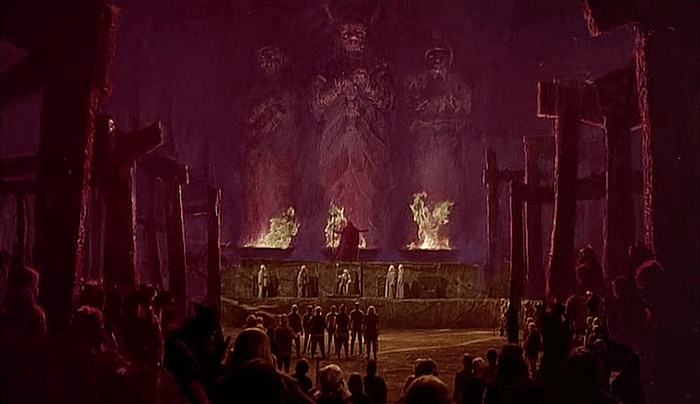
The company has taken a few ambitious swings throughout its history, dedicating considerable budgets to films it expected audiences to gravitate towards only to see them rejected en masse. The Island at the Top of the World is perhaps the most notorious of Disney’s failed franchise starters, as the adventure blockbuster, initially viewed by the company as a synergetic goldmine with sequel and theme park potential, is today a largely forgotten film known only by the most devout Disney enthusiasts and those scrolling through the chasms of Disney+. A rather haphazardly stitched story that too often resorts to plot conveniences and deus ex machinas, the 1974 production follows an expedition’s trek to the mythic ‘place where whales go to die’ in search of its financier’s son; what they find is an arctic island made an oasis by volcanic heat, a completely isolated location that’s been settled by an ancient Viking civilization unmarred by the passage of time.
The plot wears its Jules Verne influences on its sleeve, and it largely only serves as a means to string together dated, if not captivating enough, action set pieces that often center around the Hyperion airship, which Disney very much viewed as the star of the film. The bulk of the movie’s exciting moments include the vibrant cetacean balloon, with the company likely expecting the Hyperion to become a cinematically iconic vehicle à la the Nautilus; it did not, with the film underwhelming critically and making but a whimper at the box office.
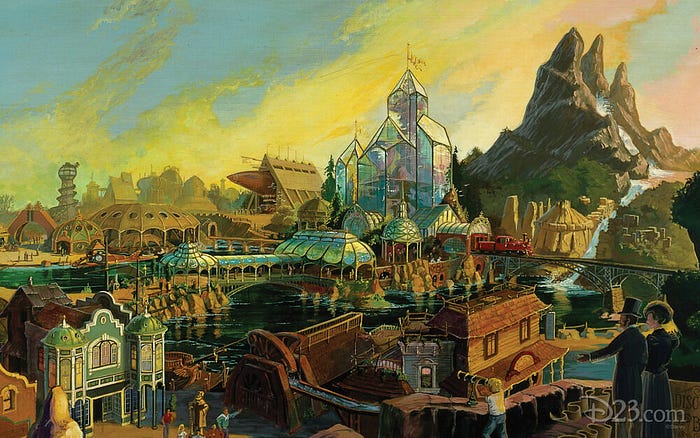
What makes The Island at the Top of the World unique amongst Disney’s failed blockbusters is that its franchise ambitions did tangibly manifest beyond the film itself. Famed Imagineer Tony Baxter, whose fingerprints can be seen all over Disney’s international theme parks, included the Hyperion airship as the visual centerpiece of his fabled ‘Discovery Bay’ pitch that was in consideration for Disneyland throughout the late 1970s and 1980s; a meticulously planned land heavily influenced by Victorian-era science fiction and rich in original lore, Discovery Bay’s primary E-ticket, per Mouseplanet, would have been a motion simulator set in the Hyperion that took guests through scenes similar to those seen in the film. The land, in its originally pitched form, was never constructed due, in small part, to The Island at the Top of the World’s underperformance; that said, remnants of the concept can be seen across Disney’s parks today in the form of themed areas like Mysterious Island at Tokyo DisneySea and Discoveryland at Disneyland Paris, which itself features a counter service restaurant built around a recreation of the airship.
The initial Discovery Bay blueprint, which again drew direct inspiration from The Island at the Top of the World, also included incredibly early renditions of attractions and concepts that would later manifest in evolved forms around the world, the most notable examples perhaps being EPCOT’s Journey into Imagination and (though less directly) the broad Society of Explorers and Adventurers narrative that unites a significant number of Disney attractions under one proverbial roof; though itself far from the box office smash the company yearned for, The Island at the Top of the World ultimately proved to be an incredibly influential film within The Walt Disney Company, with several now beloved elements of its theme parks tracing their roots back to the picture, in some capacity.
It’s with this in mind that I suggest the company revisit the film in some way, as there exists a fun, retro adventure premise at its core. The story’s intricacies — or even the plot itself — would likely have to be significantly reworked, but the general idea of a group embarking on an expedition to a fabled island in a vehicle as visually striking as the Hyperion has promise; from a Disney Parks enthusiast’s perspective, it would also be cool to see the concept for a Hyperion E-ticket attraction dusted off and manifest alongside the experiences it indirectly helped shape, assuming the film performs well.
Independence Day (1996, 20th Century Studios)
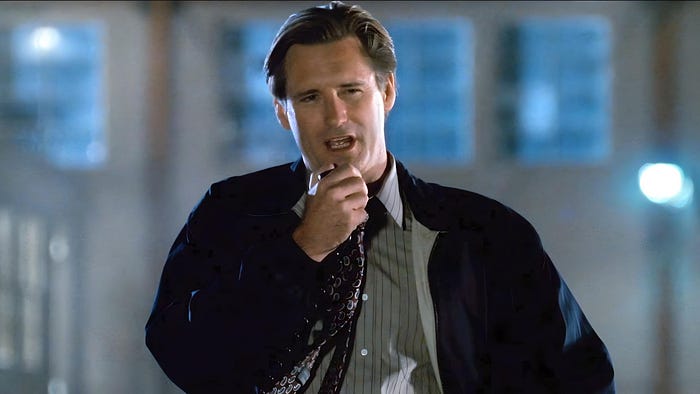
Disney has seemingly put into motion plans for all of 20th Century’s major IPs since its 2019 acquisition of the studio, releasing new Avatar, Alien, Predator, Planet of the Apes, Home Alone, and Night at the Museum films either theatrically or on the Disney+ streaming service while commencing development on new Maze Runner, The Fly, and Master and Commander iterations. With this in mind, it’s borderline unfathomable that Disney has sat idly on Independence Day, a 1996 alien invasion smash hit that was celebrated at the time of its release and is fondly remembered today as some of the better popcorn fare to emerge from the 1990s.
This can perhaps be chalked up to the fact that 20th Century itself revisited the property shortly before being folded into the House of Mouse, releasing Independence Day: Resurgence in 2016 in what was supposed to spark a series of films; the legacy sequel was critically panned while earning less than 50% of its predecessor’s worldwide box office toll, this not even accounting for inflation. Audiences demonstrated a general lack of interest in the Independence Day IP as recently as nine years ago, with the spreadsheets perhaps suggesting to Disney that a decade is insufficient time to let a brand rest before attempting another reboot.
That said, one can’t imagine the company holding off forever, as the IP boasts the advantageous attributes of being not only generally well-remembered as a brand, but of having an endlessly exciting concept that’s tried-and-true when it comes to blockbuster cinema. Audiences still show up for bombastic summer schlock when it’s properly scheduled and marketed, and no premise ushers the smell of butter-drenched popcorn into one’s mind quite like that of aliens invading Earth and destroying our landmarks. Independence Day: Resurgence likely sits heavy on Disney’s mind as it ponders what to do with the IP, but the film that the company should perhaps instead focus on is Twisters, a 2024 follow-up to the 1996 Helen Hunt and Bill Paxton vehicle that was ironically in theaters at the time of Independence Day’s release; Twisters features only scant references to its predecessor, but it garnered rave critical and audience feedback as it earned over $260 million domestically on the basis of strong marketing, scheduling, and generally looking like a good time.
Nostalgia sells (something Disney knows all too well), and Independence Day, thanks to its broad but eternally engaging premise and brand value, seems ripe to be a profitable summer franchise for the company. Whether a tangential sequel à la Twisters or a more direct remake, there’s immense promise in the idea of another alien-invasion disaster movie, with the IP even having theme park potential (who doesn’t love corporate synergy?).
Atlantis: The Lost Empire (2001, Walt Disney Animation Studios)
Perhaps the most frustrating aspect of Disney’s insistence on adapting its animated canon into live-action films is that the library contains a handful of entries that would genuinely lend themselves well to physical storyteling — they’re just not among the studio’s most iconic, and the company, thus, does not view them as the infallible hits that films like the altered renditions of Beauty and the Beast and The Lion King figured to be.
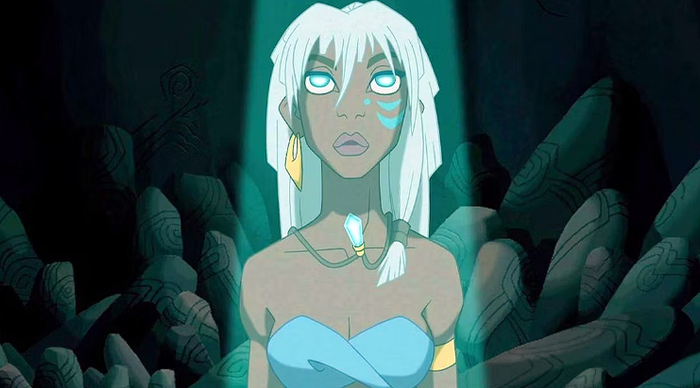
Movies like The Black Cauldron and Treasure Planet have the bones of potentially engaging and successful live-action films (with alterations), but neither of these efforts met commercial expectations and are, thus, generally viewed as footnotes to the Walt Disney Animation Studios canon. Atlantis: The Lost Empire is another film that falls into this category; the 2001 sci-fi epic, despite its grand ambition and general quality, underperformed at the box office relative to expectations (grossing $186 million on a roughly $100 million production budget), prompting Disney to cancel its multi-pronged franchise plans that included a television series and an E-ticket roller coaster at Magic Kingdom.
The company has made only scant references to the film since its release, but it’s seemingly generated renewed interest in recent years as children who grew up with the movie reach adulthood; though Disney’s ‘live-action remake’ fascination has grown a bit tired, Atlantis: The Lost Empire seems like one of only a handful of movies that fans would be genuinely interested in seeing adapted into a new medium. There are several scenes and set pieces throughout the film that, while stunning and memorable in superb 2D animation, would translate well to live-action, with the original movie having the general feel of an action blockbuster as opposed to the traditional fairy tales the studio generally adapts. Though Disney’s live-action remakes exist primarily to get updated iterations on known (and conceivably profitable) brands back into theaters, it would be cool to see the company use the fad to give a second life to a franchise it once had significant hopes for, to take a second crack at turning Atlantis intothe synergetic behemoth it’s long had the potential of being.
Reign of Fire (2002, Touchstone Pictures)
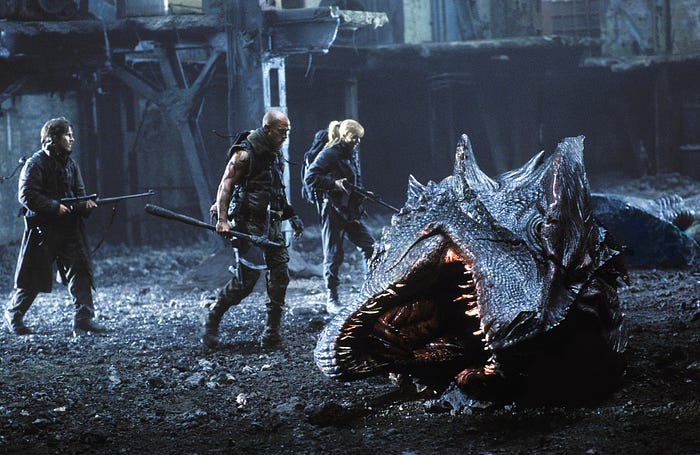
Dragons. Need I say more?
I don’t expect that you said ‘yes,’ but in the event that you did: Reign of Fire is the type of movie that one reads the synopsis of and thinks, “Wow, how haven’t I seen this?” Led by a star-studded cast that boasts Matthew McConaughey, Christian Bale, and Gerard Butler, the 2002 blockbuster blends post-apocalyptic and traditional fantasy elements to craft a wholly unique setting that’s simultaneously medieval and industrial, a world that’s been sent back centuries (sans some modern, largely militaristic technology) due to the re-emergence of dragons. With humanity scattered and on the brink of extinction at the hands of the ever-looming fire-breathing threat, the film follows Quinn Abercromby (Bale) and American militarist Denton Van Zan (McConaughey) as they attempt to exterminate the dragon species by killing its patriarch in London.
Sounds like the foundation of a fun film, right? A post-apocalyptic action flick that puts a more overt fantastical spin on the premise, creating a singular world theoretically rich in compelling characters and interesting power dynamics? With dragons?! Released amid the early-21st-century fantasy boom sparked by the success of the Lord of the Rings and Harry Potter adaptations, one would be forgiven for reading that premise and assuming that Reign of Fire — produced by Disney’s more adult-centric Touchstone Pictures banner and distributed by the company proper — became a successful summer franchise for the conglomerate.
https://www.youtube.com/watch?v=Xd2hHvq-SEA
But you know this isn’t the case. Though fun on paper, Reign of Fire is ultimately an irredeemably grim, narratively inconsistent, and generally unremarkable blockbuster that, despite its concept and cast, is less than the sum of its parts. It’s 100 minutes of wasted potential, a forgettable movie that could perhaps best be likened to unfulfilling drive-thru fare prepared with the ingredients of a gourmet meal. Critics and audiences seemed to share this sentiment, with the film receiving mixed reviews as it grossed only $82 million worldwide against a $60 million budget.
Unexceptional nature of the original movie aside, Reign of Fire still has meat on the conceptual bone. There’s something inherently captivating about the idea of dragons, with the mythical beasts evoking a sense of awe and wonder that people will demonstrably pay to see realized on the largest screen possible. The conceit of these fantastical creatures leveraging their power over modern society opens a wide range of story possibilities across numerous genres; imagine a political thriller about a government reacting to their re-emergence, or a character study about a person whose way of life is destroyed by a dragon attack, or a children’s adventure movie about a group of kids overcoming hardships as they escape a group of dragons. There’s always the traditional summer blockbuster route, as well.
Disney has the opportunity to explore a litany of avenues with the concept, with each path having a different intended audience. The company, today, lacks theatrical post-apocalyptic and traditional fantasy franchises across all of its studios, with Reign of Fire having the potential to fill that void; an updated take on the premise would be far from a guaranteed success, but if Disney can’t find a writer to craft an interesting story set in a modern quasi-wasteland ravaged by dragons, then it’s not searching hard enough.
Tomorrowland (2015, Walt Disney Pictures)

Disney’s theme park-to-film adaptation catalogue ranges in quality from good (Pirates of the Caribbean: The Curse of the Black Pearl) to bad (The Country Bears) to forgettable (Jungle Cruise) to ‘dang it, why doesn’t this exist?’ (Guillermo del Toro’s Haunted Mansion); there exists a micro-tier of films, however, that’s perhaps the most disappointing of the bunch, a ‘missed opportunity’ group of movies that never elevate above the level of pedestrian despite containing the ingredients necessary to be special.
Tomorrowland is the preeminent — and perhaps only — film in this group, as on paper, a sci-fi movie centered around a Disney Parks staple crafted as the physical representation of Walt Disney’s unwavering ambition for progress and innovation seems like a slam dunk. Throw in the fact that it was written and directed by Brad Bird (the creative behind cinematic triumphs like The Iron Giant, The Incredibles, and Ratatouille) and stars an Academy Award-winning actor in George Clooney, and you have the makings of a truly remarkable picture.
But it just… isn’t? It starts well enough, layering retro-futuristic aesthetics with esoteric Disney Parks references and a distinct feeling of optimism about the future. These elements persist throughout the two-hour runtime, but they progressively fade as they give way to generic sci-fi ideas, a predictable story, and a message that may cause the audience to leave their viewing with a goose egg due to the force with which they were beaten over the head with it. It concludes on a bright note with a clear thematic resolution, but the viewer is just left feeling… empty? As though the film’s brightest elements — its retro-futuristic look and almost tangible feeling of hope — were relegated to the background for far too much of its runtime?
There exists a great movie somewhere in the webbing of Tomorrowland — it’s just not the run-of-the-mill, unremarkable sci-fi picture we ultimately received. That’s why the concept deserves another set of creative eyes; I’m not implying that a new Tomorrowland movie should narratively expand on the 2015 effort, but there’s a distinct warmth and sincerity to the central premise that makes it worth taking another swing at. Tomorrowland, despite constantly being at risk of becoming technologically obsolete, has resonated with Disney Parks fans for generations thanks to its aesthetic and genuine optimism; a trip back to the conceptual drawing board to hone in on and amplify these elements could result in a more memorable film that lives up to its inherent potential. The company is reportedly in early development on a Space Mountain movie, so perhaps we’ll receive another Tomorrowland-adjacent outing sooner rather than later.
The Muppets
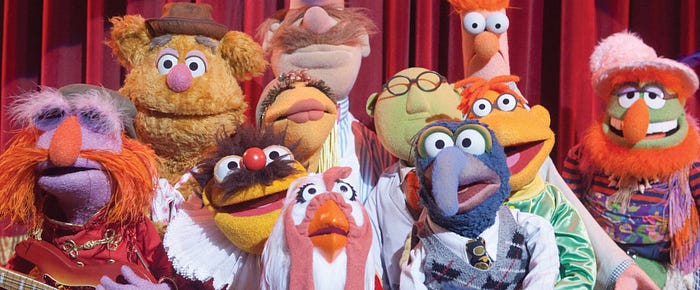
I pulled out a 1950s low-budget psychological horror film, so please let me take the layup.
What more do I have to say about The Muppets? It’s one of the most iconic IPs of all time, an entity as structural to comedy as it is to puppetry. Disney has attempted to usher the property back into the mainstream in several ways since formally acquiring it in 2004, producing Muppets-centric theatrical films, network sitcoms, television specials, and everything in between; though generally able to capture the brand’s trademark comedic style and intangible magic, these productions seemingly haven’t generated returns on a scale the company finds impressive or noteworthy, causing contemporary Disney to view The Muppets as a backburner property.
It’s been over a decade since The Muppets last graced the screen at your local multiplex (2014’s Muppets Most Wanted), and the last three non-children’s centric Muppets series (2015’s The Muppets, 2020’s Muppets Now, and 2023’s The Muppets Mayhem) have been canceled after one season. Disney seems content to sit idly on the property despite its historic cultural relevance, and one could even argue that the company is scaling back on its usage of the brand across its various arms; Grand Avenue, a Muppets-themed micro-area at Disney’s Hollywood Studios, is set to close later this year to make way for a Monsters Inc.-inspired mini-land, and with it will go Muppet*Vision 3D, a riotous film-based attraction that commenced operations in 1991. The property will still have some representation in the park in the form of a rethemed Rock ’n’ Roller Coaster, but a slapdash overlay of a near-30-year-old roller coaster seems negligible compared to the final major project worked on by Jim Henson prior to his death.
I could wax lyrical about The Muppets until I’m blue (or, rather, green) in the face, but I’ll save you the time considering the already protracted length of this article. Muppets fans deserve more Muppets media. Comedy deserves more Muppets media. Few properties are as inherently joyous as The Muppets, and it’s high time that Disney give it the care it deserves.
Be sure to continue to follow Boardwalk Times for more coverage of The Walt Disney Company.
Support Boardwalk Times on Ko-Fi.
Support Boardwalk Times by shopping on Boardwalk Store:
If you like this article. Subscribe to my free newsletter Boardwalk Times: Stories from the Seashore, a monthly dose of Disney, its businesses, and the wider themed entertainment industry.
Kyle Silagyi is a columnist for the Boardwalk Times


