Halfway through the tour, the most important man in the theme park industry was fighting back tears.
It was an exhausting, hot, triumphant night for Garner Holt. He was leading multiple tours through his warehouse factory, where the majority of the animatronics in the world are built, as part of his “Return to Rainbow Ridge” event – a benefit for the Carolwood Foundation as well as an opportunity to show off his refurbishment of an original engine and passenger car from Disneyland’s Mine Train Through Nature’s Wonderland (1960) attraction.
The temperature outside in Redlands, California, at 5:00 PM in mid-October was over 100, and some of the air conditioning had failed in the warehouse. The schematics of the event had begun to slip away from Garner’s crew, and timing was becoming erratic between the tours and the on-stage panels in the other building and the dinner, but Garner, being the kind of man he is, just kept pushing forward. By the third tour, the one I was on, he was still cheerful and generous, and overheated and tired. When we stopped at the human-sized animatronic mouse, and Garner told us that making these particular characters was the biggest break his company had ever gotten (“He bought this building.”), it was understandable that there might be a slight hitch in his voice and some emotion being barely contained.
“He’ll always have a place of honor here.”
The mouse in question? No, not that one. This one!
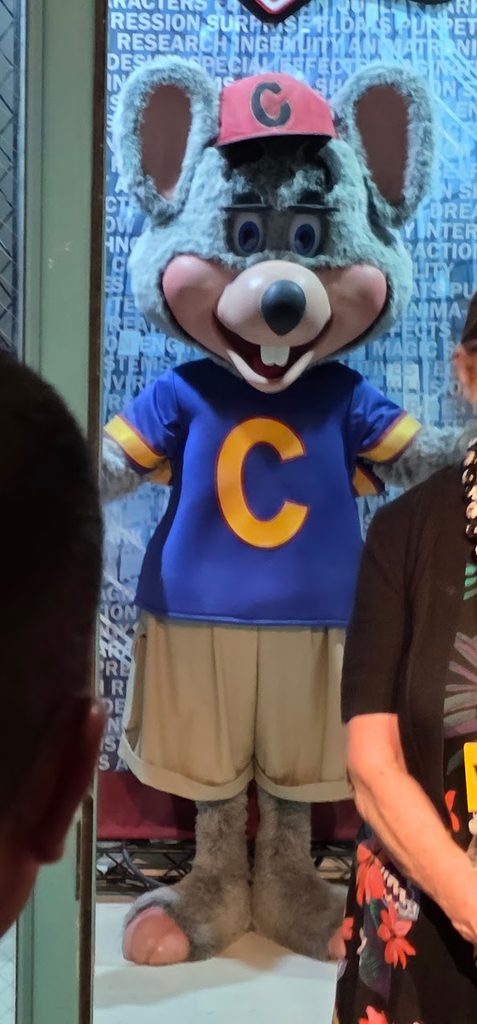
In some ways, this night was a confluence of all the elements that had made up the core of this company that has more than 500 animatronics in Disney parks alone.
Bob Gurr was there, the man who advised and encouraged Holt early on, refusing any payment other than a bowl of soup at Mimi’s Cafe.
Floyd Norman was there, the classic animator who’d worked directly with Walt Disney. Charles Entertainment Cheese, as mentioned, was well represented. Yesterland’s Werner Weiss was there, representing one of the longest-running Disney park fan sites. And, to close the circle, the whole evening was a celebration of the first theme park attraction to ever use the term “audio-animatronics”, the Mine Train Through Nature’s Wonderland.
It was as if the man had refurbished the engine and its faux-tender from the classic attraction and then rode it all the way back to the beginning of the industry of which he is now the king.
Despite all the talk of Fantasyland as Disneyland’s heart and soul, by 1960 it was clear that Frontierland was where all the action was. Between The Golden Horseshoe Revue, Mark Twain Steamboat, Sailing Ship Columbia, Tom Sawyer Island, and the newly updated Mine Train, Frontierland was massive, visually coherent, and fully fleshed out.
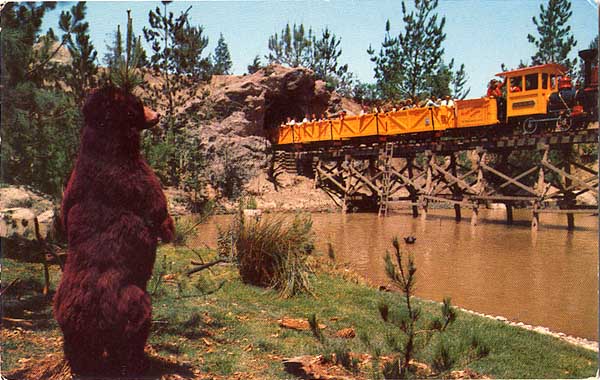
It was the first of Disney’s Lands to peak and was arguably never better than this period. The Mine Train was its Jungle Cruise.
Peppered with dozens of what they then called audio-animatronics but which were really only slightly more advanced versions of the simple repetitive motion mechanical figures than the Jungle Cruise had, the Train was a whirlwind tour through landscapes inspired by many of Walt Disney’s award-winning True Life Adventures documentaries. The figures added additional realism and comedy to the 16-minute tour, at least as much as the designers could get with their maximum movement allotment of one minute to move and then reset the action.
“The slowest cam motors we could find were one rpm. So the longest action we could program was one minute, including the reset.”
Bob Gurr
The evening proper began in Garner’s Garage, a community maker space that the Garner Holt Foundation and the Garner Holt Education Through Imagination organizations use for their outreach work. We mingled, perused the auction items, and waited for our turns to take a tour of the warehouse with Garner.
I had a long chat with Larry Boone of the Carolwood Foundation, who was either cosplaying as Dallas McKennon or just hadn’t changed out of his railroad engineer clothes from his day job. (I suspected the latter because they suited him so well.)
Soon my tour came up, and Garner took us to see the reconstructed Mine Train vehicles, as well as a number of other attractions and vehicles that he’d collected and refurbished over the years. Then it was into the actual working factory where all photos were forbidden.
It was like walking into Willy Wonka’s chocolate factory in so many ways. We saw figures from Disneyland’s Haunted Mansion that were being stored while the Nightmare Before Christmas overlay was in place. At different stages of completion, pieces of a massive animatronic cat — a figure so large that Holt told us that they were having to account for wind shear — were being worked on for a park in Mexico. We saw many, many animatronic birds, some for the kits that the company’s education wing ships out, some for attraction replacements, and one being built to be donated to a local pediatrician’s office.
One thing one sees when visiting Garner Holt Enterprises is stacks on stacks of animatronic body parts (so okay, maybe not EXACTLY Willy Wonka). They are on shelves, in boxes, on tables, everywhere. Garner explained that when the Disney Company decided that they could no longer afford to store replacements, Garner made a deal to buy the entire warehouse of parts for a small fee.
Now he sells them back to Disney when they need them.
Robot, robot, everywhere a robot; some we recognized and some that were mysteries. Curtains were raised for those particularly mysterious pieces that were too secret for the likes of us.
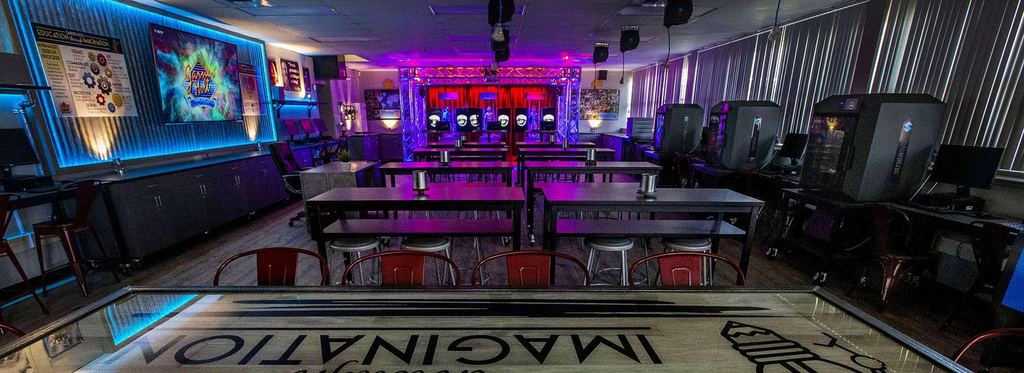
Back in Garner’s Garage, dinner service had begun. I missed the first course, but not to worry, the food was good and plentiful anyway. Finding my packed-to-the-gills swag bag, I sat down with some lovely folks and, as we ate, the show began.
First up was an interview on-stage with Bob Gurr, one of two gentlemen in attendance who worked directly with Walt Disney. If it’s an iconic Disneyland vehicle, Bob Gurr probably designed it. In typical Bob Gurr fashion, he had a lot to say, taking each question as a launching point for a hilarious, and often chaotic, discussion of everything from the working of the train engine to the cams for the animal animatronics.
At 95 years old, Bob Gurr could still recite part numbers used under a train engine’s chassis. Sixty years ago.
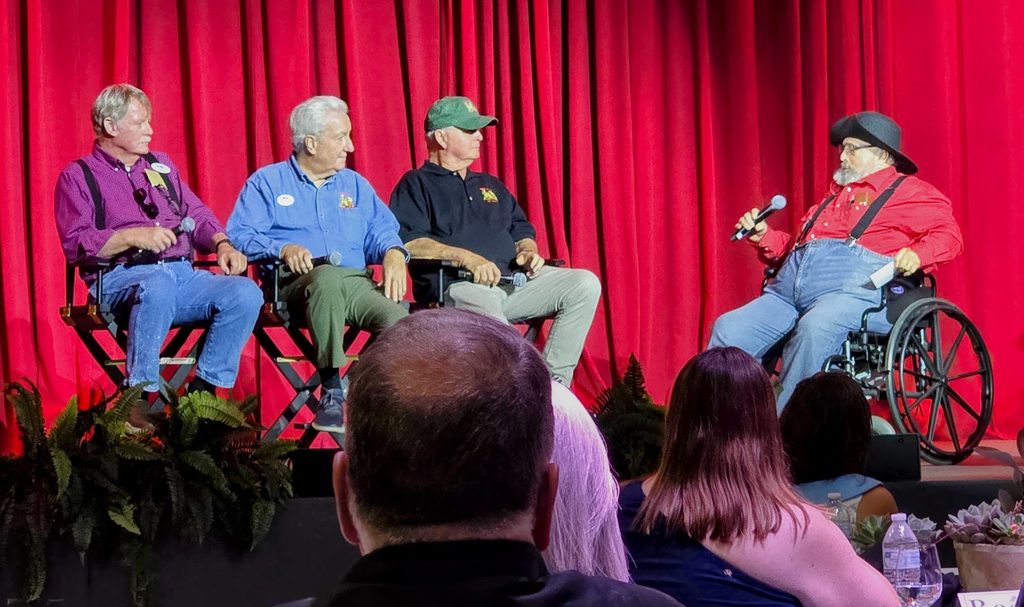
After Bob somehow brought his talk in for a landing, it was time for three of the surviving members of The Order of the Red Handkerchief to come on-stage.
The Order of the Red Handkerchief was formed on a day when ride operators for the Mine Train got put on-call as the rains were too heavy in the park. At a nearby bar, they formed the Order, which includes anyone who ever ran or worked on the trains.
John (J.J.) McMasters, Dan Nichols and John McCoy reminded us of a simpler time, where the interactions between Disneyland Cast Members and guests were less formal and, to hear them tell it, more fun. We learned the origin of “The Guy Who Hates Snakes” and heard some harrowing derailment tales.
The final panel was Garner himself with Walt Disney’s granddaughter, Joanna Miller. Bill Butler asked the questions for this heartfelt and philosophical remembrance of the Train — both Holt and Miller as young children on the Train appeared on overhead slide photos during the talk — and of Walt Disney himself.
Earlier, during our tour with Garner, in another introspective moment, he said that the entire theory of the work they do at Garner Holt Productions was that they wanted to do something that Disney and his original teams would’ve been proud of. It must have been a dream for the man, then, when Joanna Miller, after exiting the stage, ran back on just to say, “Before I go, I need to say this. Garner, Grandpa would’ve been proud of you.”
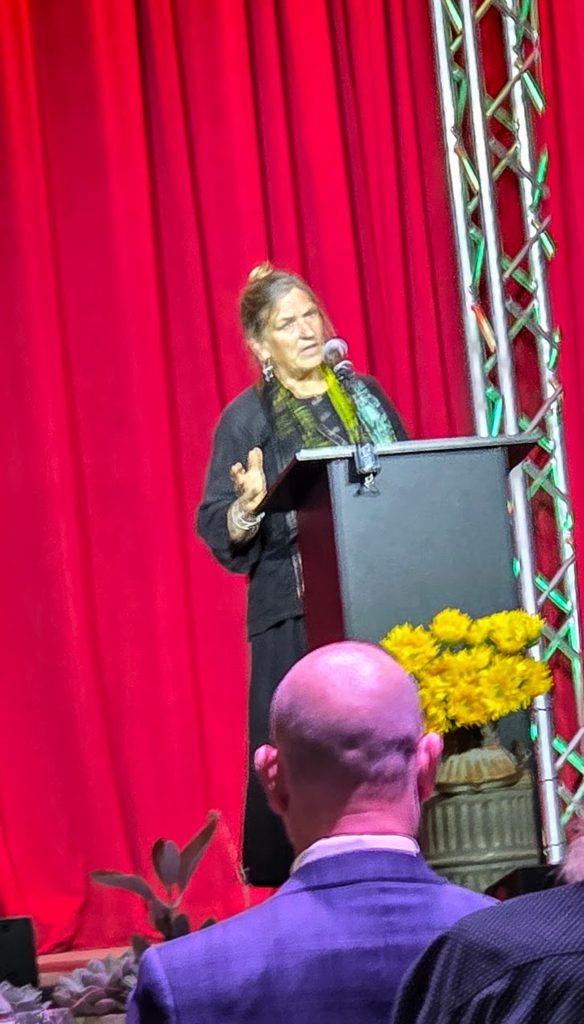
It was a lovely capper to a long evening and a real button to the still ongoing yet already legendary career of Garner Holt.
I wasn’t done yet, though. I had two things left to do before scuttling back to my motel. I wanted to go meet Michelle and Noe Valladolid, whose “Manufacturing the Magic” podcast was one I’d enjoyed for some time. They couldn’t have been sweeter.
I also wanted to ask legendary animator Floyd Norman a question I’d had for some time. So I approached the man who had worked directly with Walt Disney, who’d animated on films such as Jungle Book and Sword in the Stone, and what did I ask?
“What was it like to work on the original ‘Fat Albert’ special?”
He, also, couldn’t have been nicer.
It was a glorious evening in Redlands, California, of friends and icons and icons who became friends. Walt Disney’s theme park legacy is maintained, honored, and continued right there, in the House that Chuck E. Cheese Built.
Support Boardwalk Times
Be sure to follow Boardwalk Times for more coverage of The Walt Disney Company.
Kelly McCubbin is a columnist for Boardwalk Times